


The rapidly evolving off-grid power landscape in Southeast Asia demands a robust and well-mapped partner ecosystem capable of translating market opportunities into sustainable energy access solutions. Identifying key local companies with proven competencies in off-grid power installations, alongside targeted software-using segments, is pivotal to effectively bridge demand with technology-driven deployment. This section illuminates those critical stakeholders whose operational expertise, sectoral reach, and geographic presence position them as natural collaborators for Kenetics Energy’s advanced energy management system. Their active participation will decisively influence market adoption, operational synergies, and scalable impact in the region’s energy transition narrative.
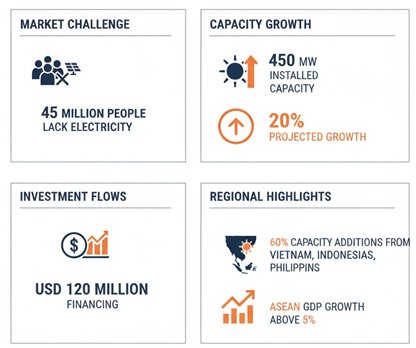
Building directly on the established market context that forecasts growth opportunities, the focus here narrows to profiling capable companies and user segments strategically aligned to off-grid and distributed energy solutions. By analyzing their core capabilities, sectoral specialization, and geographic positioning across Southeast Asia’s most dynamic and underserved energy markets, this section provides a granular partnership roadmap. The interplay between these regional actors and software-enabled energy users not only highlights commercial potential but also clarifies the operational realities and user needs that Kenetics Energy’s system must address, ensuring strong market integration and co-creation potential. Notably, the off-grid power capacity in Southeast Asia currently stands at 450 MW with a projected additional capacity of 90 MW expected over the next six months, underscoring a robust and expanding market opportunity for collaboration and technology deployment [Chart: Off-Grid Power Capacity Growth Projections].
Leading Local Companies Driving Off-Grid Power Deployment
Southeast Asia’s off-grid power segment is underpinned by a suite of agile local companies that exhibit deep technical knowledge, strong community engagement, and proven project delivery across rural and remote geographies. Top-tier enterprises such as Solar Philippines, B. Grimm Power in Thailand, and IndoGreen in Indonesia have distinguished themselves through large-scale solar mini-grid projects, leveraging localized engineering expertise and inclusive operating models. These companies often combine system installation, operation and maintenance, and last-mile energy access services, enabling them to navigate complex regulatory landscapes, supply-chain challenges, and diverse community needs effectively.
In Vietnam, firms like REE Corporation are recognized for their strong foothold in distributed renewable energy project development, with demonstrated capabilities in integrating solar PV with battery storage at off-grid and rural electrification scales. Similarly, Cambodia’s Phare Ponleu Selpak Social Enterprise plays a critical role in deploying hybrid mini-grid systems tailored to village electrification, complemented by innovative financing approaches to extend affordability. Across Myanmar, Sunlabob Renewable Energy exemplifies leadership in combining solar home systems with community microgrids, supported by advanced monitoring and management systems that underscore the importance of digitalization for operational efficiency.
These local companies share common characteristics essential for collaboration: a track record of project execution in challenging environments, existing customer bases within rural and semi-urban segments, and progressive digital integration using software platforms to optimize energy generation and consumption. Their presence spans key geographies—Indonesia, the Philippines, Thailand, Vietnam, Cambodia, and Myanmar—covering the most critical demand corridors identified in preceding analysis. This geographic dispersion is invaluable for Kenetics Energy, providing access points into high-potential territories and an established network for deploying sophisticated energy management solutions aligned with regional energy transition goals. A summary of these key local companies reveals leaders like Solar Philippines (Philippines), B. Grimm Power (Thailand), IndoGreen (Indonesia), REE Corporation (Vietnam), and Sunlabob Renewable Energy (Myanmar), who collectively drive the off-grid power deployment with specialized expertise in solar mini-grid projects, distributed renewable energy, and microgrid systems
Profiling Software User Segments and Industries Likely to Adopt Energy Management Systems
Beyond hardware-centric companies, the adoption of energy management software is increasingly driven by sectors that demand optimized, reliable, and cost-effective off-grid power solutions. Industrial users, particularly in agriculture, aquaculture, and small-scale manufacturing—sectors prevalent in rural Southeast Asia—are emerging as primary candidates. These users benefit significantly from energy management systems that maximize system uptime, reduce operational costs, and enable predictive maintenance. For example, agribusinesses in Thailand and Vietnam utilize solar-powered irrigation pumps controlled by remote energy management software to ensure consistent water supply while minimizing diesel generator dependency.
Utility companies and microgrid operators represent a crucial user segment adept at leveraging software analytics for grid stability, load balancing, and tariff management. In countries such as the Philippines, the rapid growth of community microgrids operated by local distributors and cooperatives has created fertile ground for advanced EMS adoption. These entities require granular control and real-time visibility into energy generation and consumption patterns to manage distributed assets efficiently and maintain supply reliability for residential and commercial users alike.
Commercial enterprises that rely on off-grid power—such as cold chain logistics providers, telecommunication towers, and retail chains in remote locations—constitute another vital segment. These sectors often possess the organizational capacity and financial resources to integrate energy management solutions that support sustainability commitments and cost containment strategies. The escalating importance of these sectors, particularly those engaged in sustainable cold storage and digital infrastructure growth, underscores a broadening ecosystem where Kenetics Energy’s software can create immediate operational impact.
Government agencies and non-governmental organizations implementing rural electrification projects also increasingly depend on software tools for monitoring and evaluation. Their user profiles usually extend beyond energy system data to encompass socio-economic impact indicators, creating a multidimensional demand for integrated management platforms. Collaborations with these stakeholders can enhance the systemic scalability of off-grid solutions, backed by robust data and software-enabled engagement models.
Geographic and Sectoral Mapping of Companies and Software Users
Mapping the profiles of local companies and software users across Southeast Asia reveals distinct clusters of activity that correspond to both market opportunity and infrastructural readiness. Indonesia’s archipelagic geography challenges centralized grid extension, fostering a vibrant market for island-specific mini-grid providers such as PT Len Industri and SkyEnergy Indonesia. Concentrated largely in eastern provinces, these companies address diverse demand profiles from fishing communities to small-scale industrial hubs.
The Philippines exhibits a mature ecosystem of microgrid operators and renewable energy companies, especially in Mindanao and the Visayas, where entities like Solar Philippines and REDSOL-E serve both residential and commercial users with tailored renewable solutions integrated by advanced software platforms. Here, sectoral alignment towards agriculture, telecommunication, and tourism enhances the relevance of EMS adoption.
In mainland Southeast Asia—Thailand, Cambodia, Laos, and Vietnam—the focus shifts toward hybrid mini-grids and solar home systems deployed by firms like B. Grimm Power and REE Corporation. These companies, together with socially-oriented ventures in Cambodia and Laos, service rural communities heavily reliant on agriculture and small-scale manufacturing. The geographic concentration often aligns with government rural electrification initiatives and donor-funded projects, creating synergistic opportunities for software-enabled optimization and monitoring.
Sectorally, agriculture dominates rural energy consumption, but burgeoning mini-industrial zones and digitizing businesses are progressively demanding sophisticated energy solutions across multiple countries. The convergence of these geographic and sectoral factors illustrates a mosaic of potential collaboration points where Kenetics energy’s EMS – BTGrid can offer distinct value—facilitating enhanced operational control, demand-side flexibility, and integration with diverse energy assets while aligning with local partner strengths.
References